
Industrial Coatings for Phoenix Warehouses
Epoxy floors for forklifts, polyurethane for UV exteriors, elastomeric for monsoon roofs — industrial coating systems for Phoenix warehouses.
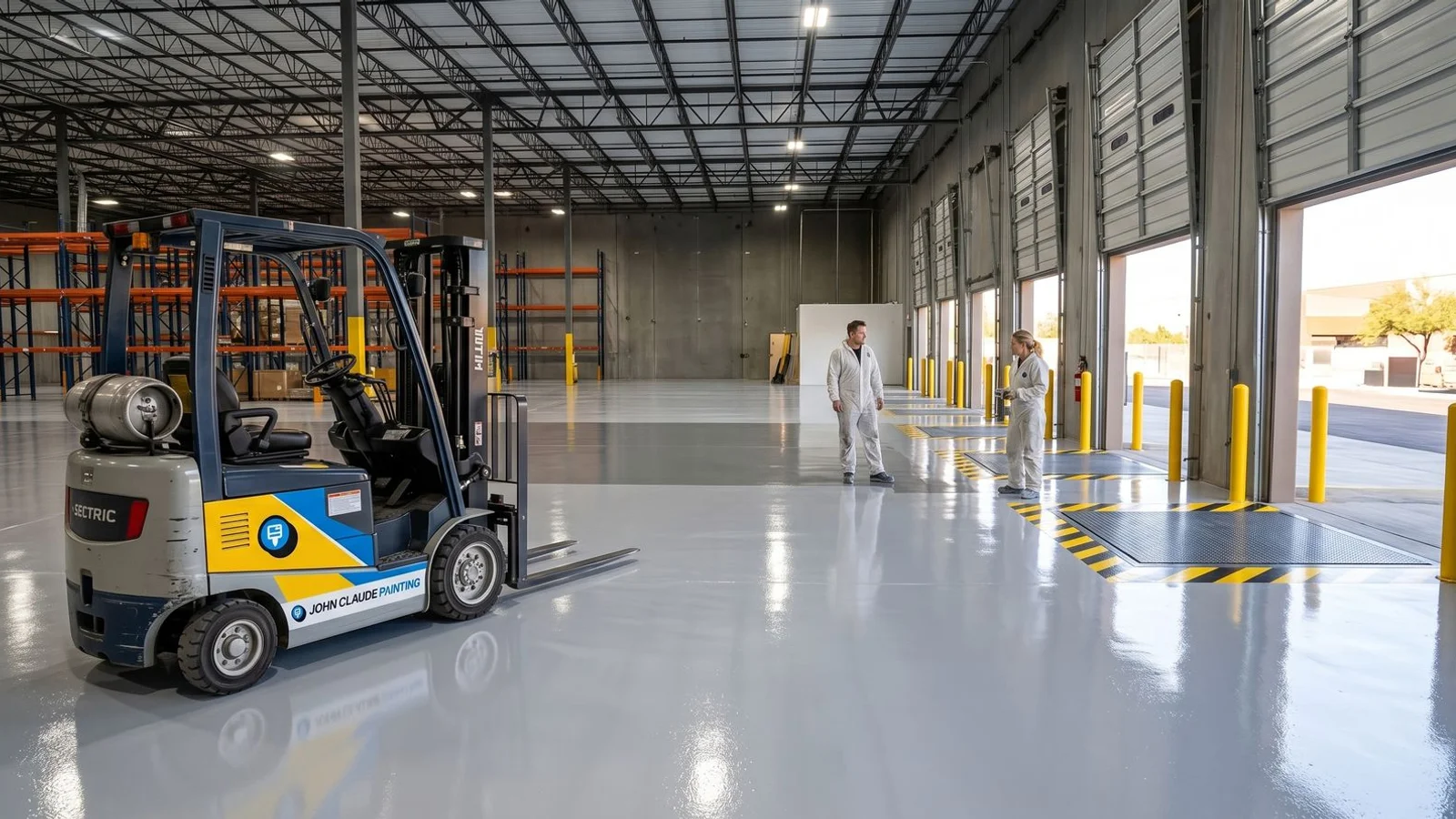
You know how quickly the Arizona desert destroys standard commercial paint jobs. Our team at John Claude Painting consistently sees generic finishes peel and crack within months under the brutal summer sun.
Protecting your facility requires specialized industrial coatings phoenix warehouse managers can rely on year-round.
Standard acrylics simply cannot handle 160-degree roof temperatures or constant heavy equipment traffic.
We are going to break down the specific floor, wall, and roof systems that actually survive our climate. You will see exact performance data, cure times, and cost estimates to help you make the best decision for your building.
Floors: Epoxy Systems
Your facility needs a full-broadcast epoxy system with a polyaspartic or polyurethane topcoat to handle daily abuse. This specific combination is the only reliable warehouse floor epoxy phoenix businesses should install for heavy machinery.
We often inspect failed DIY floors where thin, roll-on kits degraded after just a few weeks. The problem usually stems from inadequate surface preparation, which accounts for 42 percent of all coating failures according to 2025 industry data. Thin applications of 2 to 5 mils dry simply cannot withstand the weight of a loaded pallet jack.
Industrial Coatings Phoenix Warehouse Applications
Our standard process builds a highly durable surface measuring 40 to 80 mils thick. A trowel-applied basecoat receives a full broadcast of quartz or aluminum oxide while wet to create maximum slip resistance. Diamond grinding to a Concrete Surface Profile of 2 to 5 ensures the resin bonds permanently to the slab.
| System Feature | Roll-On Epoxy (DIY) | Full-Broadcast Epoxy (Pro) |
|---|---|---|
| Total Thickness | 2 to 5 mils | 40 to 80 mils |
| Traffic Capacity | Light foot traffic | 50+ forklift cycles per day |
| Heat Tolerance | Low | Up to 200 degrees Fahrenheit |
Chemical and Thermal Environments
For environments facing extreme conditions, urethane-modified cement offers superior protection against thermal shock. Food processing plants and pharmaceutical labs benefit greatly from this cementitious base. It handles hot water washdowns, steam cleaning, and mild acid spills without delaminating.
Watch out for these common installation pitfalls:
- Skipping moisture vapor transmission tests before application.
- Leaving structural cracks unrepaired, which causes the topcoat to fracture.
- Applying coatings when humidity exceeds 85 percent, leading to trapped bubbles.
Walls: Interior and Exterior
Protecting your facility requires high-build acrylic latex for inside surfaces and polyurethane topcoats for outside exposures. These specific formulations provide the necessary chemical resistance and UV defense that standard commercial paints lack.
We highly recommend using easy-clean, reflective finishes to maximize your interior lighting efficiency. A product like Sherwin-Williams Pro Industrial DTM Acrylic brightens the workspace while resisting scuffs from passing machinery. Carboline 135HB serves as another excellent option for spaces requiring a durable, wipeable surface.
Exterior Defense Systems
Your outside walls take a massive beating from the Arizona sun and monsoon dust storms. Applying an epoxy primer followed by a polyurethane topcoat creates a shield that prevents chalking and color fade. Carboline Carboguard 890 paired with Carbothane 134HG provides a proven barrier for metal, concrete, or CMU block structures.
Our teams frequently notice premature yellowing on buildings that skipped the proper UV-resistant topcoat. Using an aliphatic polyurethane ensures your exterior maintains its gloss and structural integrity for years.
Here are a few tips for evaluating wall coatings:
- Inspect metal siding for existing rust before choosing a primer.
- Match your coating flexibility to the thermal expansion rate of the building material.
- Schedule exterior painting outside of the active monsoon season to prevent moisture entrapment.
Roofs: Elastomeric Coatings
An elastomeric roof phoenix property owners install will reflect intense solar radiation and seal vulnerable seams. This liquid-applied membrane acts as a protective shield against the severe temperature swings of the Sonoran Desert.
We regularly measure untreated black commercial roofs hitting surface temperatures above 160 degrees Fahrenheit during July afternoons. This massive thermal load causes underlying materials to expand drastically, which tears seams apart and forces the air conditioning system to run continuously. A 100 percent acrylic elastomeric formula can lower those surface temperatures by up to 40 degrees.
Top Product Choices
Premium products like Tucson Rubberized 7000 or Henry Tropi-Cool deliver exceptional Energy Star-rated heat reflection. Gaco WeatherShield and GacoFlex also provide strong waterproofing capabilities that expand and contract smoothly as temperatures drop to 40 degrees on winter nights.
Our maintenance crews rely on these coatings to bridge small penetrations and add 10 to 15 years to a roof’s lifespan. Knowing when to apply the product, however, makes all the difference in long-term performance.
Use these guidelines to decide your next step:
- Recoat: The existing surface is mostly intact with only minor seam separation.
- Investigate: The building has an active leak history that requires finding the source before covering it up.
- Replace and Coat: You see widespread material failure, visible rust, or severe water ponding issues.
Environmental Windows
Timing your installation correctly prevents trapped moisture and ensures the resins cure to their full structural hardness. You must schedule coating applications around the specific temperature and humidity requirements of each product.
We schedule floor epoxy projects knowing the surface needs 24 to 72 hours of cure time before allowing foot traffic. Forklifts and heavy pallets must stay off the fresh floor for a full seven days to prevent permanent indentations. Polyaspartic systems offer a faster alternative, sometimes curing enough for light traffic in just 4 to 8 hours.
Weather Guidelines
Exterior walls generally follow standard painting weather windows, requiring dry days with moderate temperatures. Roof coatings demand much stricter attention to local weather patterns, especially during the late summer months.
| Surface Type | Minimum Cure Time | Weather Constraints |
|---|---|---|
| Epoxy Floors | 24 to 72 hours | Keep indoor humidity below 85 percent |
| Exterior Walls | Product specific | Avoid rain for 24 hours |
| Roofs | 24 hours | Avoid monsoon humidity spikes |
Our project managers actively monitor dew points and avoid applying rapid-cure roof products during high-humidity monsoon days. Excessive moisture in the air prevents the acrylic or silicone from cross-linking properly, which drastically reduces its lifespan.
Warranty Expectations
A professional coating application should come with clear manufacturer guarantees and a predictable lifespan based on the materials used. Understanding these timelines helps property managers accurately forecast future maintenance budgets.
We typically see high-quality industrial floor systems last between 5 and 15 years, depending heavily on the daily traffic volume and product class. A polyaspartic warehouse floor handling 50 forklift cycles a day will naturally wear faster than a medium-traffic epoxy room.
Long-Term Protection
Exterior polyurethane wall coatings consistently provide 10 or more years of strong UV protection before needing a refresh. Elastomeric roof coatings also carry strong backing, usually offering a 10 to 15-year manufacturer warranty if installed by a certified crew.
Our goal is always to maximize that lifespan through proper initial surface preparation. Failing to mechanically profile a concrete floor or thoroughly clean a roof will void most manufacturer warranties immediately.
Review these key factors that influence warranty coverage:
- Documented surface preparation methods (like diamond grinding).
- Correct dry film thickness measurements taken during application.
- Routine maintenance and prompt repair of minor scratches or gouges.
Budget Ranges (Phoenix)
Current 2026 pricing for commercial coatings in Arizona reflects the cost of high-grade materials and specialized labor required for proper application. Expect to invest appropriately to secure a system that will actually survive the desert environment.
We find that a full-broadcast floor epoxy system generally ranges from $4 to $8 per square foot. Exterior urethane wall coatings cost between $3 and $6 per square foot. Standard elastomeric roof applications run from $1.50 to $4 per square foot, though complex silicone upgrades can push the price up to $8.
Variables That Impact Cost
These budget ranges swing significantly based on the amount of substrate preparation required before the first drop of resin touches the surface. Extensive diamond grinding, shot-blasting, or patching deep concrete spalls will push a project to the higher end of the scale.
| Coating Project | 2026 Estimated Cost (Per Sq. Ft.) |
|---|---|
| Full-Broadcast Floor Epoxy | $4.00 to $8.00 |
| Exterior Urethane Wall Coating | $3.00 to $6.00 |
| Acrylic Elastomeric Roof | $1.50 to $4.00 |
Our estimators always factor in facility access and operational downtime when calculating the final proposal. Projects that require night shifts, weekend work, or complex phasing to keep your warehouse running will naturally incur higher labor costs.
You can review our commercial painting service page for a complete walkthrough of our industrial project scope and execution.
Securing the right industrial coatings phoenix warehouse standard requires matching precise chemistry to extreme climate demands.
Your facility deserves a defense system built for the long haul.
Contact our team today to schedule a comprehensive site evaluation and get a precise quote for your upcoming project.
Quick Answers
What epoxy holds up to forklift traffic?
Full-broadcast troweled epoxy at 40-80 mils with polyaspartic or urethane topcoat — not roll-on systems.
Do Phoenix warehouses need elastomeric roofs?
For aging metal and low-slope built-up roofs — yes. Elastomeric bridges seams and reflects heat.
What coatings resist industrial chemicals?
Catalyzed epoxy and novolac-modified epoxy for acids and solvents; polyurethane for alkaline exposure.
Keep Reading
Commercial Exterior Painting Cost for Office Buildings and Retail
What a full commercial exterior repaint runs per square foot in Phoenix, plus th...
Multi-Unit Apartment and HOA Repainting Programs
Reserve-study planning, phased sequencing, resident notices, and warranty handov...
Scheduling Commercial Painting Around Business Operations and Tenants
How to repaint occupied commercial and multi-unit buildings without disrupting o...
Need a Real Estimate?
We'll walk your property and write a scoped proposal within 24 hours — no cost, no obligation.