
Painting Company Red Flags in Arizona
Unlicensed, uninsured, cash-only, no-prep — the exact red flags that signal a painter will leave you worse off in Arizona's desert climate.
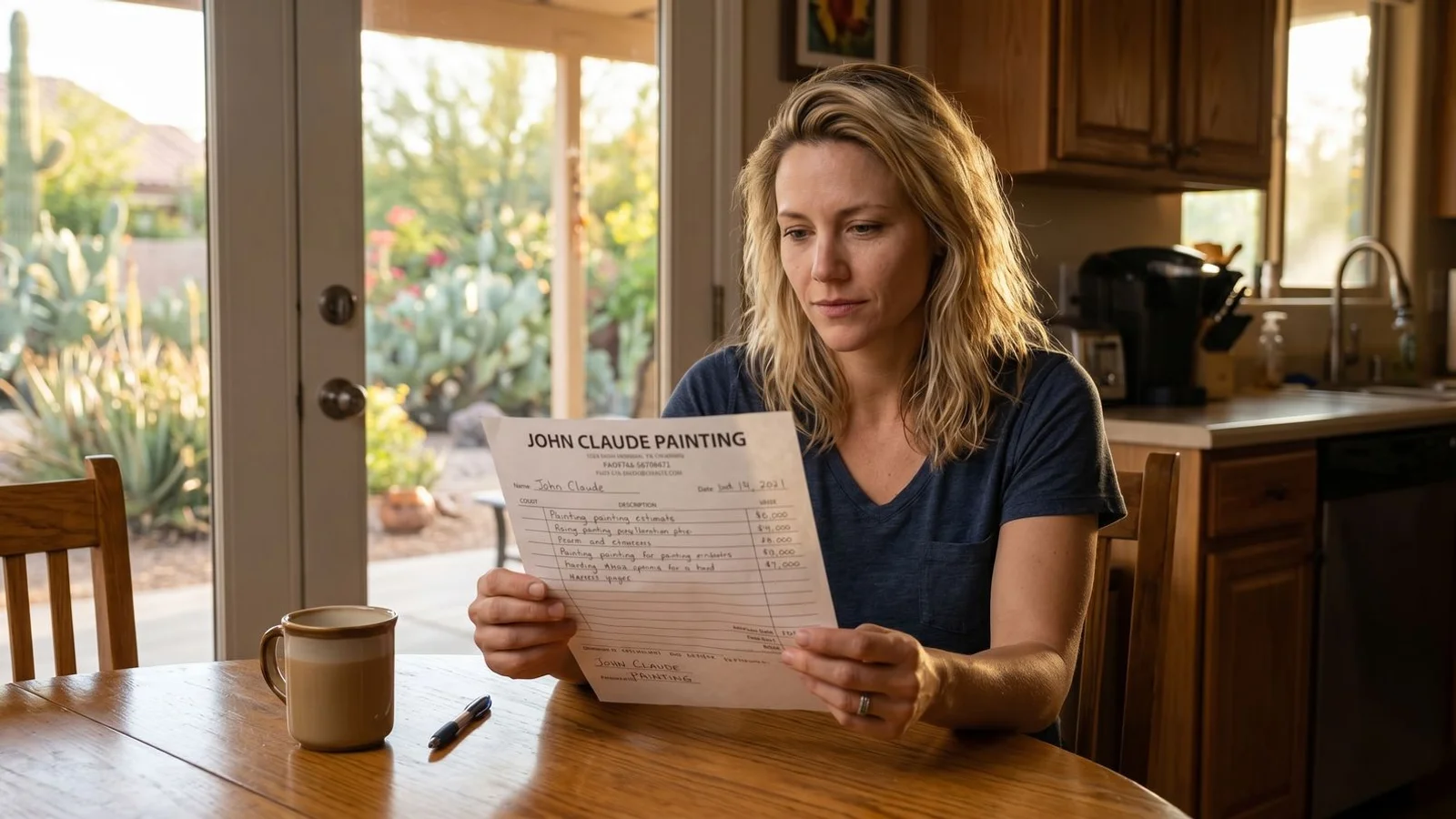
Our team sees it happen every spring in the Phoenix Valley when residents rush to refresh their exteriors. A ridiculously low quote arrives, and the temptation to save a few dollars is completely understandable. The reality is that the local market is flooded with the typical cash-only painter operating under the radar.
We are going to walk you through exactly what these bargain bids actually mean for your property.
Understanding these painting contractor red flags Arizona professionals warn about will protect your home from expensive repairs. Let us look at the ten most common warning signs to watch for before you sign a contract.
Red Flag #1: No ROC License Number
Our recommendation is to use the free AZ ROC “Contractor Search” online tool to verify their active status. Arizona requires an active Registrar of Contractors (ROC) license for any painting project exceeding $1,000. A legitimate professional will proudly display this six-digit number on their estimate, business cards, and vehicles.
We always warn homeowners that hiring an unlicensed worker means you forfeit essential legal protections. Operating without this license violates state law and is classified as a Class 1 misdemeanor. The penalty for a first offense includes a fine of at least $1,000 and potential jail time.
We strongly advise you to always ask for the ROC license number upfront. If the contractor hesitates or makes an excuse, walk away immediately. You will simply have to cover the cost of a complete repaint out of your own pocket if things go wrong.
Red Flag #2: Cash Only
Our team finds that a flat demand for cash means the person is actively avoiding a paper trail. A cash-only demand is the clearest signal that you are dealing with an illegitimate operation. Legitimate Phoenix painters accept checks, ACH transfers, or credit cards as standard practice.
We suggest watching out for specific financial and legal risks tied to cash payments. This payment method usually indicates the contractor lacks a legitimate LLC or corporate structure. A 2 to 4 percent credit card surcharge is entirely normal for a valid business.
- No business banking: They cannot secure proper vendor accounts.
- Tax evasion: They are likely skipping state and federal tax obligations.
- No complaint tracking: They operate entirely outside of ROC oversight.
- Loss of the Recovery Fund: Cash jobs with unlicensed painters disqualify you from the $30,000 Arizona Residential Contractors’ Recovery Fund.
We tell every client that the temporary discount of a cash job is never worth the permanent risk. If a painter refuses a verifiable payment method, find someone else. Protecting your investment requires a clear financial record of the transaction.
Red Flag #3: No Certificate of Insurance
Our standard policy is to provide a Certificate of Insurance (COI) proactively during the estimate phase. Any professional painter should produce this document within 24 hours of your request. The COI must name you as the certificate holder and clearly show active coverage.
We want you to know that the average general liability policy for a painter in Arizona costs just $60 to $80 per month. A real contractor has absolutely no excuse to skip this basic business expense. Without insurance, a minor accident on your property can become a major financial disaster.
We highly recommend verifying that the document explicitly lists these critical coverages:
- General liability: A $1 million policy is typical to protect your property.
- Workers’ compensation: Essential coverage in case a crew member gets injured.
- Policy expiration dates: Verification that coverage extends through your project dates.
Arizona premises liability laws dictate that homeowners can be held responsible if an uninsured contractor gets hurt on site. If uninsured damage occurs to your home, those repair costs will come straight out of your pocket.
Red Flag #4: No Prep Scope in the Estimate
Our experience shows that Phoenix paint fails rapidly when the crucial preparation stage is rushed. The written estimate must list specific, detailed preparation steps rather than vague promises. A bid that simply says “prep as needed” or skips prep entirely is a massive shortcut.
We refuse to skip these steps because they are the foundation of a lasting finish. Arizona dust storms and extreme heat require rigorous surface cleaning before a single drop of paint is applied. Proper preparation on a stucco home includes power washing dirt and filling cracks with an elastomeric patching compound.
We ensure every thorough estimate lists these exact line items:
- Power washing: Removing all oxidation and desert dust.
- Stucco or drywall repair: Fixing structural flaws.
- Caulking: Sealing gaps around windows and doors.
- Priming: Applying a bonding primer to porous surfaces.
- Sanding: Smoothing out peeling areas on wood trim.
A cheap paint job applied over dirty stucco might look okay today, but it will start chalking and peeling in just two years. A professionally prepped exterior in the Valley should easily last seven to ten years.
Red Flag #5: One Coat Specified as “Sufficient”
Our crews know that a single layer of paint simply cannot withstand the blistering Arizona sun. Most premium paint manufacturers require two coats for their warranty coverage to remain valid. A painter quoting a single “refresh coat” at a tight price is cutting the material and labor required for true durability.
We choose top-tier desert paints like Dunn-Edwards Evershield because they are engineered specifically for Phoenix heat. The manufacturer guidelines explicitly call for a two-coat minimum to achieve full UV protection. Following these specifications is the only way to prevent rapid fading and chalking.
We highly recommend reading our guide on two-coat vs one-coat interior painting for the complete technical details. If a contractor tells you that one coat with a built-in primer is enough, they are compromising your project. The finish will not hold up to the elements over time.
Red Flag #6: Verbal Warranty Only
Our contracts always include clear warranty terms in writing to protect both parties. A warranty you cannot hold in your hands is not a real warranty. The Arizona Registrar of Contractors mandates a two-year workmanship warranty for licensed residential contractors.
We advise clients to demand a written document outlining these specific elements:
- Duration in years: Clear start and end dates.
- Explicit scope: Defining if workmanship, product, or both are covered.
- Coverage voids: What specific actions cancel the warranty.
- Remediation requests: The exact process for getting issues fixed.
An unlicensed painter Arizona residents hire will often rely on verbal promises to avoid this legal obligation entirely. If they hedge on putting their guarantee on paper, you should assume there is zero coverage.
We have seen too many homeowners left stranded when a verbal agreement is conveniently forgotten. Without terms in ink, resolving a defect becomes a stressful and expensive battle. True professionals stand behind their work with a legally binding document.
Red Flag #7: Demanding Full Payment Upfront
Our business model never requires full payment before the paint even touches your walls. Standard Phoenix practice requires a 25 to 35 percent deposit at signing, with the remainder due upon completion. Anyone demanding the entire payment upfront is either running into cash-flow problems or setting up a scam.
We strongly advise you to walk away from any contractor asking for full payment on day one. Legitimate painters hold commercial trade accounts at stores like Sherwin-Williams. These accounts allow them to float the cost of materials without needing your cash immediately.
We want you to maintain control of your project from start to finish. A professional contractor will only request the final payment after you have completed a punch-list walk-through. Paying in full upfront destroys your leverage to ensure the job is done correctly.
Red Flag #8: Pressure to Sign Today
We strictly guarantee our estimates for 30 days to give you ample time to make an informed decision. High-pressure sales tactics are a massive red flag in the home improvement industry. A phrase designed to create false urgency is a clear warning sign.
We suggest taking at least a few days to verify credentials on the AZ ROC website. Watch out for statements like “this price is only good if you sign right now.” Aggressive pressure often points to traveling scam crews looking to secure a quick deposit before leaving town.
We know that a confident professional will gladly wait for you to feel comfortable. Reputable contractors understand that you need time to compare quotes and check references. They let the quality of their estimate speak for itself.
Red Flag #9: No Physical Business Address
Our local headquarters proves that we are rooted in this community for the long haul. A legitimate Phoenix painting company operates from a registered physical office or commercial warehouse. A cell phone number and a rented truck are not enough to establish a stable enterprise.
We frequently see fly-by-night operators using P.O. boxes or fake residential addresses to hide their identity. State LLC registration and ROC bonding require a verifiable physical location. A simple Google Maps search is usually all it takes to confirm the address exists.
We always recommend plugging the business address into an online map before signing anything. If the result shows a UPS store or a vacant lot, cross that contractor off your list immediately. This makes it impossible to serve them with legal papers if a dispute arises.
Red Flag #10: Unmarked Van, Unbranded Crew
Our team always arrives in clearly marked vehicles wearing professional attire. Uniformed crews arriving in a branded commercial van send a strong signal of reliability. It shows the company has stable operations and takes pride in its public image.
We view unbranded setups as a clear warning sign of an uninsured, unvetted crew. The Arizona ROC actually requires licensed contractors to display their license number on their commercial vehicles. Random unmarked labor rolling up to your house in personal cars suggests the opposite of a structured business.
We know that professional branding is a minimal investment that any serious contractor will make. A professional appearance includes company shirts, a logo, and the six-digit ROC number visible on the truck. Protecting your property means knowing exactly who is walking onto it.
What Legitimate Looks Like
Our company strives to meet and exceed every single one of these industry standards. Reviewing this checklist will help you separate the genuine professionals from the costly amateurs.
It is always better to spend a little time verifying credentials than to pay twice for a failed project.
We want your next home improvement project to be a complete success. For quick contrast, a legitimate Phoenix painter will always provide several specific guarantees:
- Carries an active ROC license and shows it on the van.
- Accepts secure payments like a check or credit card.
- Produces a current COI within a single business day.
- Itemizes specific surface prep steps in the written estimate.
- Specifies the exact product line and requires a two-coat application.
- Writes the warranty duration and terms directly into the contract.
- Accepts a reasonable deposit followed by a final payment schedule.
Avoiding these painting contractor red flags Arizona buyers frequently face will save you thousands.
We invite you to utilize our free resources to make the best decision for your property. Your home deserves the highest quality protection available in the Valley.
Use our full how to choose a painting contractor in Phoenix checklist to vet your shortlist before signing.
Quick Answers
What happens if I hire an unlicensed painter in Arizona?
You lose ROC recourse if work fails, insurance often won't cover damage, and any lien rights are weakened — a cheap quote becomes expensive fast.
Is a cash-only painter always a red flag?
Usually yes — it signals an unregistered operator avoiding insurance, taxes, and ROC oversight.
What warranty language should I require in writing?
Duration in years, what it covers (workmanship vs product), what voids it, and what the remediation process is.
Keep Reading
How to Choose a Painting Contractor in Phoenix
A Phoenix homeowner's checklist for vetting painters: ROC license, insurance, pr...
How to Prepare Your Home for Painters
Move furniture, clear access, plan for pets and HVAC — a concrete pre-job checkl...
What to Expect When Hiring a Painter: Start to Finish
The full painter engagement walk-through: estimate, contract, prep, paint, punch...
Need a Real Estimate?
We'll walk your property and write a scoped proposal within 24 hours — no cost, no obligation.