
Painting Over Wallpaper: Remove or Paint Over?
When you can paint over wallpaper safely, when removal is non-negotiable, and which primer actually adheres — a Phoenix homeowner's guide.
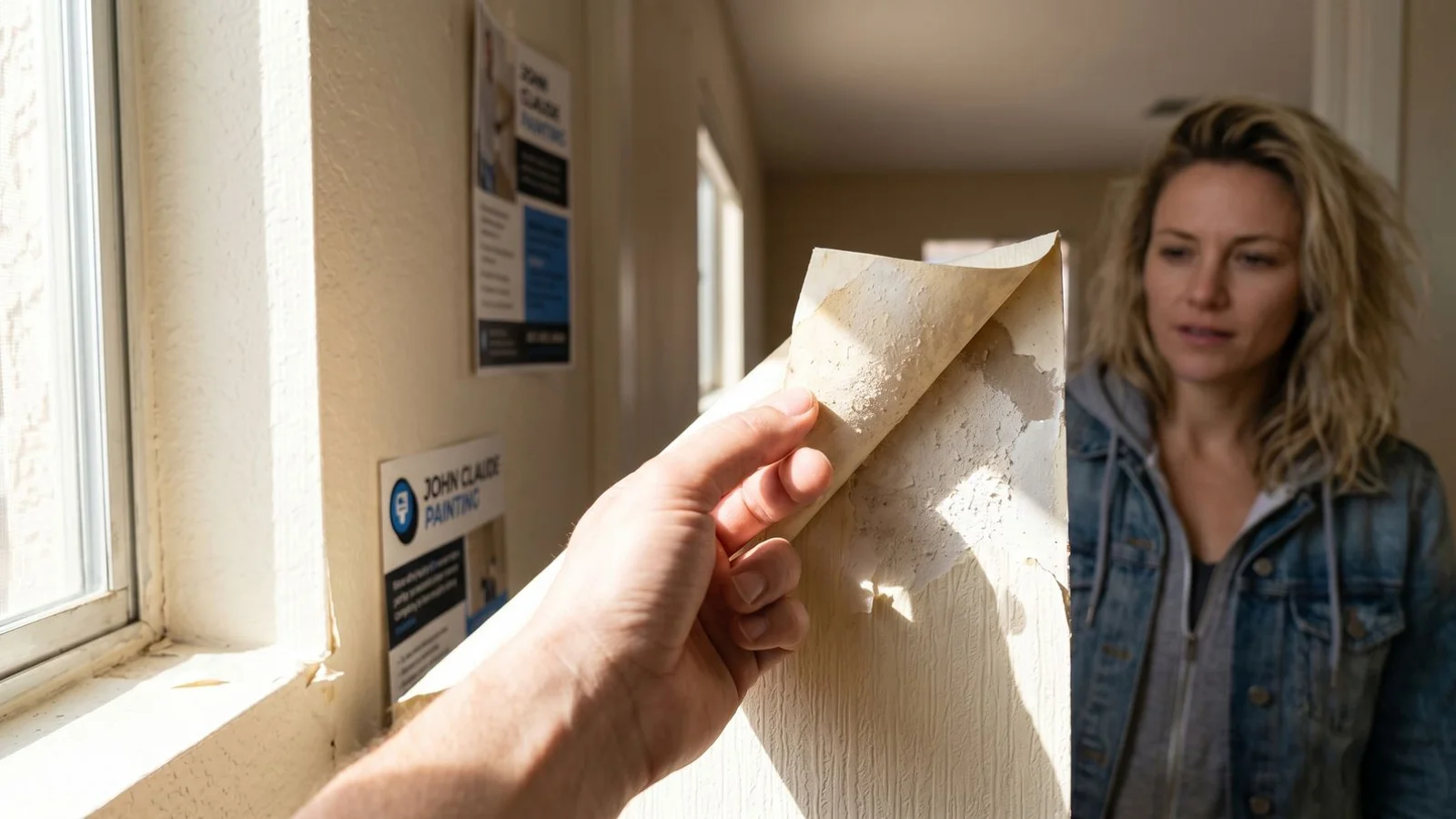
We at John Claude Painting hear the “should I remove wallpaper or paint over it” question from Phoenix homeowners constantly.
The answer depends entirely on the specific material currently on your walls.
Some flat papers take paint beautifully after proper sealing.
Our team focuses on reliability, successfully painting over well-adhered wallpapers to save clients time and money.
This approach requires strict preparation to avoid bubbling and peeling down the road.
Review the exact rules below for making the right call for your home.
When Removal Is Mandatory
We find that forcing paint over the wrong material always leads to disaster.
Certain wallcoverings are chemically and structurally incompatible with latex topcoats.
Textured finishes will bleed right through a new layer of paint.
Our crews always strip grasscloth because the woven natural fibers absorb moisture and warp.
This delicate material requires a specialized gel remover, like the ones from Roman Products, to break down the paste safely.
Vinyl-coated papers present another major obstacle for primer.
We recommend taking these plastic-like sheets down completely because paint flakes off their surface within months.
Watch out for these mandatory removal scenarios below:
- Peeling or lifting edges (paint won’t bond where adhesive has already failed)
- Vinyl or solid sheet vinyl (paint doesn’t adhere to plastic without a specialized bonding primer)
- Grasscloth and fabric (texture shows through any paint, making removal required)
- Multiple layers (thick stacks of paper flex differently and crack over time)
When Paint-Over Is Acceptable
Pristine wall surfaces are the only exception to the removal rule.
Our painters sometimes recommend painting directly over traditional paper if the conditions are absolutely perfect.
Modern peel-and-stick wallpapers, which are trending heavily in 2026, should always be peeled off instead of painted.
Press a strip of painter’s tape firmly against the wall and rip it off quickly to test the old adhesive.
We consider this tape test the best way to determine your next steps.
If any paper comes away with the tape, you must remove wallpaper before painting the room.
Look for these specific criteria before approving a paint-over project:
- Flat paper that is fully adhered with zero bubbles
- Painted-paper types already sealed with a standard latex paint
- Smooth seams that show absolutely no signs of curling
- Tight adhesion to sound, undamaged drywall
Prep for Painting Over Wallpaper
Our strict policy is to never use a water-based primer on wallpaper.
Water reactivates the old wallpaper paste and creates massive bubbles under your fresh coat.
The most critical choice you will make is selecting a paint over wallpaper primer.
We heavily favor Zinsser B-I-N for these tricky surfaces.
This shellac-based primer seals odors permanently and dries to the touch in just 15 minutes.
Zinsser Cover Stain is another excellent oil-based option that offers incredible adhesion, though it requires a two-hour dry time.
Our standard preparation sequence includes these exact steps:
- Clean the surface thoroughly to remove grease and smoke residue.
- Sand the seams lightly to feather the edges smooth.
- Fill any visible joints or torn spots with standard joint compound.
- Apply your chosen oil-based or shellac primer.
- Spot-sand the dry primer, then apply two high-quality finish coats.
Seams Are the Hardest Part
Even perfectly adhered paper has visible vertical lines where the panels meet.
A fresh coat of paint will highlight these tiny ridges instantly.
We spend a significant amount of time addressing seams during any paint-over project.
Skim coating is the professional technique used to create a flawless, uniform finish.
This involves spreading a thin layer of joint compound over the seams and sanding it flush.
Our crew follows this exact method for a perfectly flat wall:
- Skim-coat joint compound over every single seam.
- Feather the compound 6 to 8 inches outward on each side.
- Sand the area completely smooth, spot-prime the patches, then paint.
Skipping the skim step almost always means you see every seam at the first ray of morning sun.
Cost Trade-Off
Recent 2026 pricing data shows that basic wallpaper removal in Phoenix typically costs $1 to $2 per square foot.
We frequently answer questions about the financial difference between tearing down and painting over these walls.
Non-porous vinyl materials cost more, usually running $1.50 to $2.50 per square foot for the tear-down.
The price spread is surprisingly narrow between the two options.
Our estimates show that painting over the paper, including the required skim-coated seams, runs about $1.50 to $3.50 per square foot for the prep alone.
Most homeowners expect a simple paint job to save them an absolute fortune.
Taking the paper down resets the wall completely and eliminates any future risk of seam bleed-through.
We strongly recommend full removal for most Phoenix homes as the better long-term call.
See our interior painting service for full-scope wallpaper removal and repaint pricing.
Quick Answers
Can I always paint over wallpaper?
No. Peeling, textured, or vinyl wallpaper must come down. Flat well-adhered paper can be sealed and painted.
Which primer works best over wallpaper?
Oil-based or shellac primer. Water-based primers can reactivate wallpaper adhesive and cause bubbling.
Will the seams show through new paint?
Usually yes unless skim-coated first. Budget for joint-compound feathering if a flawless finish matters.
Keep Reading
Best Interior Paint for Phoenix Homes (Low-VOC, Desert-Ready)
Which interior paint lines actually hold up in Phoenix homes — Sherwin-Williams,...
DIY vs Hiring a Professional Interior Painter in Phoenix
Honest numbers on DIY painting: tool cost, time, skill, and resale risk vs hirin...
How Long Does Interior Painting Take in an Occupied Home?
Per-room and whole-home interior painting timelines for occupied Phoenix homes —...
Interior Painting Cost in Arizona: What Drives the Price
What Arizona interior painting actually costs per square foot and per room — plu...
Need a Real Estimate?
We'll walk your property and write a scoped proposal within 24 hours — no cost, no obligation.