
Best Interior Paint for Phoenix Homes
Which interior paint lines actually hold up in Phoenix homes — Sherwin-Williams, Dunn-Edwards, Benjamin Moore compared for desert conditions.
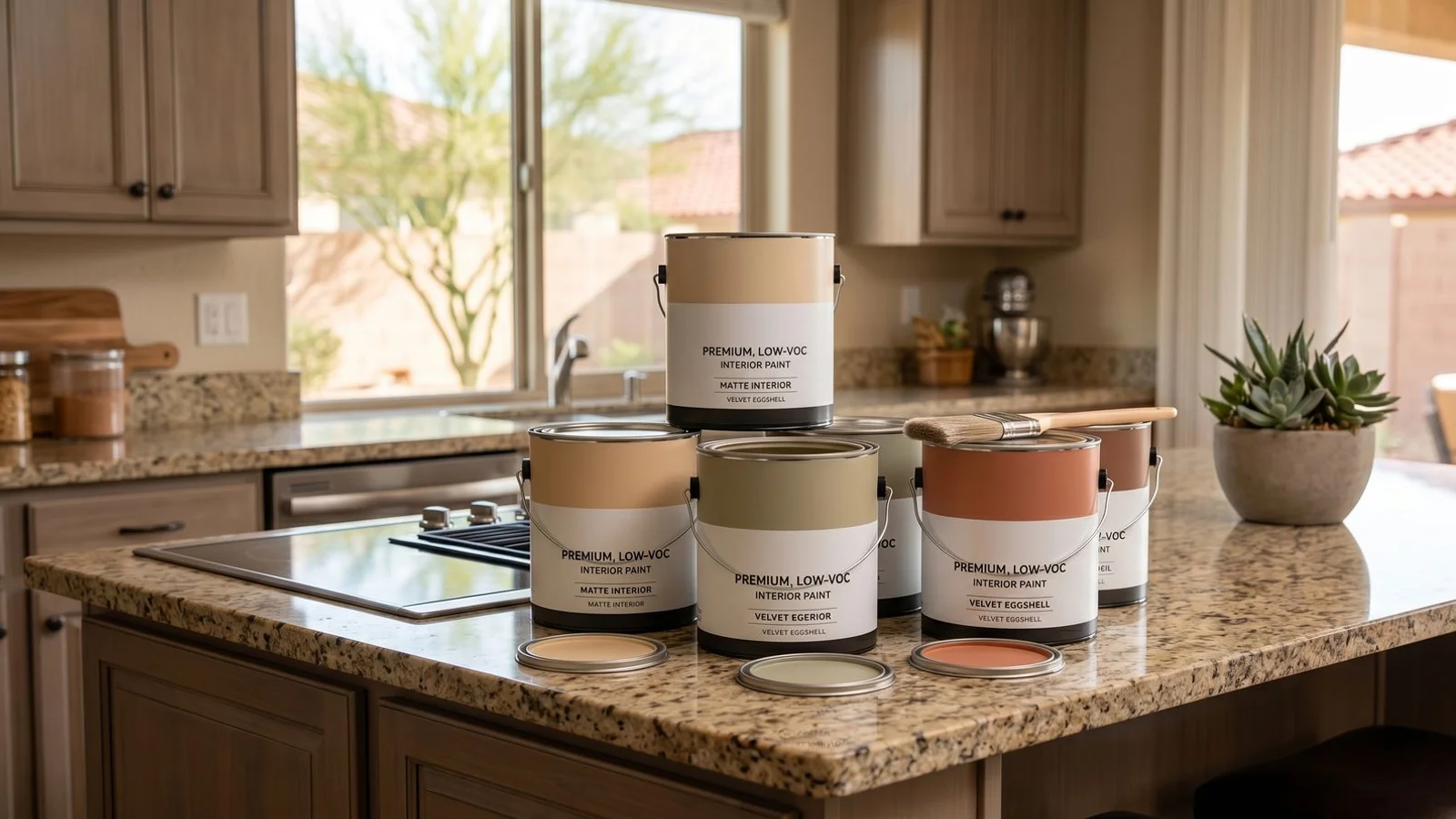
You know how quickly that fine desert dust settles on everything in a Phoenix home. We established John Claude Painting to provide homeowners and businesses with professional painting solutions centered on reliability and superior craftsmanship, so we see this daily.
The extremely low humidity in Arizona creates static electricity, which practically magnets dust straight to your drywall.
Wiping that dust off the wrong finish will leave permanent shiny marks.
You need the best interior paint Phoenix has to offer to hold its color, tolerate aggressive cleaning, and avoid filling your house with harsh fumes. We will break down the top three product lines we spec, explore the real difference in VOC levels, and outline a practical sheen guide for your next project.
Best Interior Paint Phoenix: The Three Product Lines We Use Most
Our top three choices for Phoenix homes are Sherwin-Williams Emerald for standard walls, Benjamin Moore Aura for dark accents, and Dunn-Edwards Aristoshield for trim. These specific lines represent the best wall paint Phoenix professionals use, offering the perfect balance of washability, durability, and color retention in dry climates.
Here is a quick comparison of how we deploy them across a standard home.
| Paint Line | Best Application | Key Feature | Expected Coverage |
|---|---|---|---|
| Sherwin-Williams Emerald | Main-traffic walls, kitchens, kids’ rooms | Antimicrobial agents and top-tier washability | 300-350 sq ft/gal |
| Benjamin Moore Aura | Deep accent colors (navy, charcoal, forest green) | Color Lock technology prevents pigment rub-off | 350-400 sq ft/gal |
| Dunn-Edwards Aristoshield | Doors, trim, baseboards, built-ins | Water-based urethane alkyd cures exceptionally hard | 350-400 sq ft/gal |
Sherwin-Williams Emerald for Main Walls
We rely on Sherwin-Williams Emerald as our default family-home workhorse. The advanced stain-blocking technology makes it incredibly scrub-resistant. This matters immensely in Phoenix because static cling draws dust directly to the walls.
You can wipe this paint down aggressively without leaving permanent burnish marks or shiny spots. It also features built-in antimicrobial agents that inhibit mold growth in damp areas like bathrooms.
Benjamin Moore Aura for Accent Colors
Deep, saturated colors like red or navy require a specific chemical makeup to prevent fading. We specify Benjamin Moore Aura for these dramatic accent walls.
The company uses a proprietary Color Lock technology that physically embeds pigments within binding molecules. Wiping a standard dark paint often leaves color residue on your cleaning cloth. Aura locks the pigment into the paint film, ensuring your dark charcoal wall will not fade or rub off during routine maintenance.
Dunn-Edwards Aristoshield for Trim
Doors and baseboards take a beating from shoes, vacuum cleaners, and pets. We treat trim differently than drywall, which is why Aristoshield is our clear champion here.
It is a water-based urethane alkyd. This means it behaves like a traditional, hard-wearing oil-based paint without the terrible fumes or long dry times. It cures exceptionally hard over about seven days, creating a finish that easily resists hand oils and chemical detergents.
Low-VOC vs Zero-VOC
The primary difference between these options comes down to the specific measurement of volatile organic compounds per liter. Low-VOC paint contains 50 grams per liter or less, while zero-VOC formulas drop that number under 5 grams per liter.
Both options are completely safe for occupied homes when you provide proper ventilation. We recommend low-VOC paint Arizona homeowners can trust for standard repaints where families plan to stay in the home during the project.
You will notice significantly fewer lingering odors compared to older solvent-based products.
When to Upgrade to Zero-VOC
Certain situations warrant the strictest chemical limits. We strongly suggest requesting a zero-VOC variant if anyone in your household falls into specific sensitive categories.
- Asthma or respiratory triggers: Zero-VOC limits airborne irritants.
- Expecting mothers: Minimizing chemical exposure is a simple precaution.
- Nurseries and playrooms: Young children are more sensitive to off-gassing.
- Poorly ventilated spaces: Interior rooms without exterior windows trap fumes longer.
Every major manufacturer, including Sherwin-Williams and Benjamin Moore, now offers highly durable zero-VOC lines. You no longer have to sacrifice scrubbability to get a healthier indoor environment.
Sheen Guide for Phoenix Interiors
Selecting the right sheen determines how well your walls handle cleaning and lighting. A very flat finish hides drywall flaws beautifully, but it acts like a sponge for dirt and scuffs.
Our default recommendation for any high-traffic zone is to use an eggshell or satin finish. Many homeowners make the critical mistake of requesting flat paint everywhere to achieve a specific modern look.
In the arid Phoenix environment, fine dust naturally settles on walls. You cannot aggressively wipe down flat paint without ruining the texture.
Recommended Sheens by Room
We stick to a proven formula for pairing rooms with their ideal gloss level. Here is exactly how to distribute your finishes to maximize longevity.
- Flat or Matte: Reserve these exclusively for ceilings and very low-traffic formal dining rooms.
- Eggshell: Use this as your standard choice for bedrooms, living rooms, and adult spaces to gain a soft reflection and moderate washability.
- Satin: Apply this in kitchens, bathrooms, and children’s rooms where the slightly higher gloss repels moisture and withstands frequent scrubbing.
- Semi-Gloss: Dedicate this tough finish to doors, trim, baseboards, and window casings.
- High-Gloss: Keep this for rare, dramatic architectural accents or custom furniture pieces.
Primer: When You Actually Need It
Most standard repaints in well-maintained homes do not require a separate, dedicated primer. Your money is almost always better spent applying a full, high-quality second coat of your finish paint.
We only mandate a full coat of primer when dealing with specific chemical or structural barriers. Modern paints with built-in primers handle everyday adhesion perfectly, but they fail against heavy stains or raw materials.
Situations That Demand Primer
You must apply the correct bonding agent before painting if you encounter any of these five scenarios.
- Bare Drywall: Unpainted surfaces require a dedicated PVA drywall primer to seal the porous paper.
- Bare Wood: Raw lumber needs a strong bonding primer to prevent natural tannins from bleeding into your topcoat.
- Drastic Color Changes: Transitioning from dark navy to bright white requires a tinted primer to reduce the total number of coats needed.
- Stain Blocking: Water marks, smoke damage, or children’s crayon drawings demand a shellac-based product like Zinsser BIN to lock the stain permanently.
- Extensive Drywall Repairs: You must spot-prime any fresh joint compound patches so the repairs do not flash through the final sheen.
What to Avoid
Selecting the wrong materials or cutting corners on application will cost you significantly more in early repainting. We see homeowners fall into the same traps year after year to save a fraction of the budget upfront.
Arizona’s dry air and intense UV light filtering through windows will quickly degrade cheap products.
Products and Practices to Skip
Our teams consistently remove and fix these specific failures in local properties. Stay away from the following shortcuts to protect your investment.
- Contractor-grade builder paints: These budget lines save about $20 per gallon initially, but they chalk out and lose their sheen within three years.
- Using Behr Premium Plus Ultra as a primary whole-home solution: This is a perfectly fine option for a quick DIY guest bedroom, but it does not hold up to heavy family traffic across an entire house like premium lines do.
- Kilz Complete latex as a topcoat: Unscrupulous contractors sometimes rebrand this as a finish coat, which is weak because it lacks the durability needed for a final wall surface.
- Single-coat visual refreshes: Skipping the second coat leaves thin spots, uneven sheen, and automatically voids guarantees from the manufacturer.
Read up on two-coat vs one-coat interior painting to understand the specific warranty implications.
You can also review our interior painting service to see exactly how we match premium products to every room on a job site.
The Short Answer: Best Interior Paint Phoenix
The most reliable approach for a standard Phoenix family home involves pairing Sherwin-Williams Emerald or Benjamin Moore Aura on your walls with Dunn-Edwards Aristoshield on your trim. This combination guarantees maximum washability and incredibly hard-wearing doors.
We default to low-VOC paint Arizona standards require to keep indoor air quality safe, but always provide zero-VOC options upon request.
You should strictly reserve primer for bare surfaces, drastic color changes, or severe stains. Give your home the high-quality protection it deserves by choosing the best interior paint Phoenix has available, and ensure your contractor applies two full coats.
Quick Answers
What's the difference between low-VOC and zero-VOC paint?
Low-VOC caps at 50 g/L; zero-VOC is under 5 g/L. Both are safe for occupied homes; zero-VOC suits chemical-sensitive households.
Which finish is best for Phoenix living rooms?
Eggshell or matte. Flat hides drywall imperfections but can't be scrubbed; satin and above can highlight texture in low-humidity light.
Do I need a primer before repainting interior walls?
Only for bare drywall, major color changes (dark to light), stain-blocking, or repaired patches. Most repaints skip dedicated primer.
Keep Reading
DIY vs Hiring a Professional Interior Painter in Phoenix
Honest numbers on DIY painting: tool cost, time, skill, and resale risk vs hirin...
How Long Does Interior Painting Take in an Occupied Home?
Per-room and whole-home interior painting timelines for occupied Phoenix homes —...
Interior Painting Cost in Arizona: What Drives the Price
What Arizona interior painting actually costs per square foot and per room — plu...
Painting Over Wallpaper: Remove or Paint Over It?
When you can paint over wallpaper safely, when removal is non-negotiable, and wh...
Need a Real Estimate?
We'll walk your property and write a scoped proposal within 24 hours — no cost, no obligation.