
Commercial Exterior Painting Cost: Office and Retail
What a full commercial exterior repaint runs per square foot in Phoenix, plus the drivers that move office and retail quotes up or down.
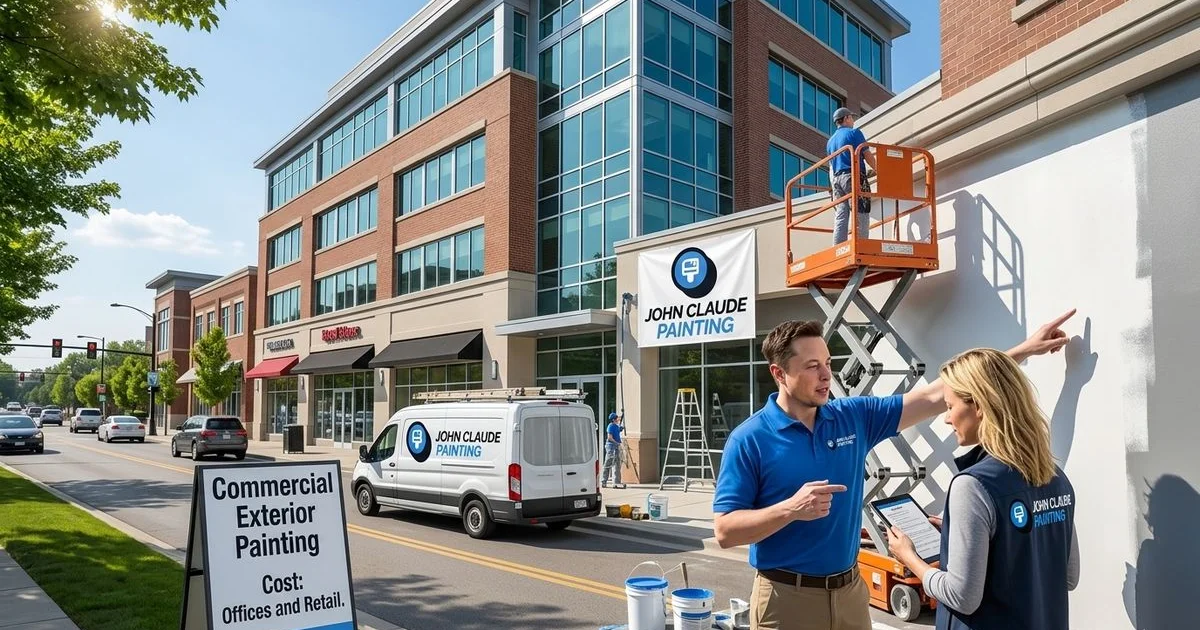
You know how tough it is to nail down the exact commercial exterior painting cost office buildings require for a full budget approval.
If you manage an office park or a retail strip in the Phoenix metro, the final price rarely fits a single number.
Square footage, surface condition, and tenant logistics all push the figure up or down.
Our team at John Claude Painting sees this frustration every day. Property managers need reliable data, not just vague estimates.
This guide pulls together the exact ranges sweeping across Maricopa County in 2026. It outlines the cost levers you can actually control.
Let’s look at the data, what it actually tells us, and how you can defend your budget in the next board meeting before requesting a single quote.
The commercial exterior painting cost office buildings face in two minutes
Most Phoenix office and retail exteriors land between $2.50 and $6.00 per square foot for a full repaint in 2026. A standard 5,000-square-foot single-story office usually runs $12,500 to $30,000.
A mid-sized retail strip lands closer to $40,000 to $90,000.
We base these numbers on current Maricopa County labor rates and material costs. The final figure shifts heavily based on your surface condition, building height, and required timeline.
Heavy elastomeric systems and elevated access always push the top end higher.
Per-square-foot ranges by scope
Commercial exterior pricing tracks the same basic drivers as residential work, but with massive extra weight on access, signage, and tenant logistics. You must also factor in the extreme UV exposure your property faces in the Valley.
Here is what we see locally for baseline 2026 pricing.
- Intact stucco, standard 100% acrylic, light prep: $2.50 to $3.50 per sq ft
- Intact stucco, premium acrylic (Dunn-Edwards Evershield): $3.50 to $4.75 per sq ft
- Hairline-cracked stucco with elastomeric topcoat (Sherwin-Williams Loxon XP): $4.75 to $6.50 per sq ft
- Heavy stucco repair plus elastomeric: $6.00 to $8.50 per sq ft
- Two-story or parapet uplift: add 25% to 40% over single-story equivalent
Our experience shows a premium acrylic upgrade adds roughly 20% to 30% to the line item upfront. In return, repaint cycles often stretch from a measly five years to ten or more under the brutal Arizona sun.
This long-term math is what most facility managers actually care about.
Whole-building price brackets
The per-square-foot math rolls up into predictable total project budgets for properties across the Phoenix metro. Below is exactly how those numbers look for different facility sizes in 2026.
| Property type | Typical size | 2026 budget bracket |
|---|---|---|
| Single-story office | 3,000 to 5,000 sq ft | $9,000 to $30,000 |
| Two-story office building | 8,000 to 15,000 sq ft | $30,000 to $90,000 |
| Small retail strip (4 to 6 tenants) | 6,000 to 10,000 sq ft | $20,000 to $55,000 |
| Mid-sized retail center | 12,000 to 25,000 sq ft | $40,000 to $140,000 |
| Large multi-tenant complex | 30,000 sq ft and up | $90,000 to $300,000+ |
These brackets assume a full body repaint with trim, fascia, soffits, and entry doors included. They do not cover canopies, structural steel, parking-lot restriping, or pylon-sign refurbishing.
Those distinct elements are always scoped separately.
We typically allocate about half of every commercial exterior budget to labor and prep rather than the actual paint. That exact ratio is the simplest sanity check on any quote you receive.
What moves the quote up or down
Five core variables explain most of the spread between two quotes for the exact same property. Knowing these levers helps you read the individual line items rather than just glancing at the bottom line.
You can then make a much smarter decision for your building.
1. Surface condition
Stucco behaves like a sponge in the desert, making condition the single biggest cost lever on your bid. A heavily damaged wall requires extensive patching before a single drop of paint touches the building.
- Intact, no cracks: baseline pricing
- Hairline cracks throughout: add 15% to 25%
- Structural cracks needing a stucco specialist: add 30% to 50% or a referral
- Efflorescence or moisture issues: add 10% to 20% plus a source diagnosis
Our crews power-wash the surface, log every crack, and price repairs in clear line items. Any contractor skipping a close-up surface walk is just guessing.
This transparency lets you see what the prep work is actually buying you.
2. Building height and access
Two-story offices and parapet retail buildings need scaffolding, boom lifts, or staged ladder work. That heavy equipment plus the slower pace adds 25% to 40% over the single-story equivalent.
Tight drive aisles, light-pole proximity, and massive rooftop HVAC units also restrict lift placement. A cramped site runs much slower than a wide-open lot, even if the total square footage is exactly the same.
Equipment rental costs alone for a 60-foot boom lift can easily add $1,000 to $1,500 per week to your project.
3. Product tier
Builder-grade acrylics fade incredibly fast under intense Phoenix UV exposure. Stepping up to a premium 100% acrylic, or using an elastomeric system on cracked stucco, is the smartest high-value move for commercial work.
- Builder-grade acrylic: baseline
- Premium acrylic (Dunn-Edwards Evershield): add 15% to 25%
- Elastomeric (Sherwin-Williams Loxon XP): add 20% to 40%
- Ceramic-reinforced systems: add 25% to 35%
We highly recommend Dunn-Edwards Evershield for its superior block resistance, meaning freshly painted doors will not stick to their jambs. If your stucco has heavy hairline cracking, Sherwin-Williams Loxon XP can be applied up to 40 mils wet to completely bridge those specific gaps.
A longer repaint cycle is your real return on investment. Most boards budget on 5-to-10-year cycles, and the product tier strictly dictates if you hit that target.
4. Tenant and traffic logistics
Office and retail jobs almost always need to flex around active tenants and their customers. Night work, weekend-only schedules, and complex storefront-glass masking each add labor hours that show up on your quote.
If your center features anchor tenants with strict customer-hour rules, expect a measurable price uplift.
Our standard approach is to build a detailed, phased timeline to minimize disruption. The entire playbook is covered in detail on scheduling around tenants.
5. Trim, signage, and detail scope
The main body of the building usually paints very quickly. Trim, soffits, fascia, storefront frames, signage masking, and pylon detail work are the specific areas where labor rapidly accumulates.
- Body only: baseline
- Add fascia, eaves, soffits: 10% to 15% more
- Add storefront frames, doors, bollards: 5% to 10% more
- Tenant-specific accent colors per bay: job-specific
Multiple accent colors across tenant bays severely slow the work down and increase masking time. Fewer color transitions always equals a faster, more affordable job.
What is usually not included
Most base quotes cover standard preparation and paint application, but they exclude major capital repair work. Read every quote closely with that strict limitation in mind.
- Stucco crack repair beyond hairline width
- Wood fascia or soffit replacement
- Canopy or awning fabric refurbishing
- Pylon and channel-letter sign refinishing
- Parking-lot striping and seal-coat
- Roof-deck or parapet waterproofing
Old retail centers in Phoenix frequently hide severe wood rot directly behind painted fascia boards. Painters can easily flag this damage, but a qualified carpenter has to replace the wood before the topcoat goes on.
Plan for a small budget carve-out if your building went up before the year 2000.
Deposits and payment schedule
Arizona Registrar of Contractors rules strictly require clear payment terms on all commercial work. Most professional crews structure payments around specific progress milestones rather than demanding a single massive up-front charge.
- Deposit: 20% to 30% at contract signing
- Progress draw on larger jobs: 25% to 40% at midpoint or per-building completion
- Final: balance at punch-list sign-off and warranty handover
We always advise owners to treat any request for full payment up front as a major red flag. Under Arizona statute A.R.S. 32-1158.02, progress payments are standard procedure for large commercial contracts.
Verify the Arizona ROC license at roc.az.gov before signing anything, and keep a copy of the final warranty permanently filed with your reserve study.
How to compare two commercial quotes
Most extreme quote spreads come down to a difference in scope, not crew quality. A careful, line-item read usually closes the gap between two wild numbers.
- Itemized prep (power wash, masking, stucco repair, caulking, primer)
- Named product line and finish, not just a vague promise of “premium paint”
- Coat count, with a clear two-coat baseline stated
- Elevation breakdown by tenant bay or building face
- Schedule terms (night work, weekend hours, tenant access restrictions)
- Warranty length and mandatory inspection cadence
If your specific job spans more than one building, ask whether the contractor phases the work across fiscal years or does it in a single push. Both methods are valid options, and they simply hit your capital budget differently.
For a helpful residential reference point, see our exterior painting cost in Arizona breakdown. The raw material drivers are very similar, but the access costs and tenant variables are completely different.
Getting an accurate quote for your building
Two photos and a quick square-foot estimate are absolutely not enough for a usable commercial budget number. A short on-site walk, a moisture check on a few stucco panels, and a tenant-schedule conversation usually dial the quote within a few percent of the final cost.
Bring your reserve study, any prior coatings warranty, and a written list of tenants with strict customer hours to the meeting.
Our team scopes Phoenix offices and retail centers daily as part of our commercial painting service, and we can usually return a fully written estimate within two business days. To lock in the exact commercial exterior painting cost office buildings require, call a reputable professional today and get your property assessment started.
Quick Answers
What does commercial exterior painting cost per square foot in Phoenix?
Most office and retail repaints run $2.50 to $5.50 per square foot. Heavy stucco repair, two-story access, or elastomeric systems push that to $5.50 to $8.00.
How much does it cost to repaint a typical 5,000 sq ft office building?
Plan on $15,000 to $35,000 for a single-story office in the Phoenix metro. Two-story access, parapet walls, or extensive trim can move that into the $35,000 to $55,000 range.
What pushes a retail strip-center quote higher than expected?
Tenant-hour scheduling, signage masking, storefront-glass protection, and parapet or canopy work are the four most common cost movers. Each one adds labor hours rather than material.
Do quotes usually include landlord or HOA paperwork?
We file Architectural Review Committee or landlord color-approval paperwork at no extra fee. Confirm this in writing with any contractor before signing.
Keep Reading
Industrial Coatings for Phoenix Warehouses: Epoxy, Urethane, Elastomeric
Epoxy floors for forklifts, polyurethane for UV exteriors, elastomeric for monso...
Multi-Unit Apartment and HOA Repainting Programs
Reserve-study planning, phased sequencing, resident notices, and warranty handov...
Scheduling Commercial Painting Around Business Operations and Tenants
How to repaint occupied commercial and multi-unit buildings without disrupting o...
Need a Real Estimate?
We'll walk your property and write a scoped proposal within 24 hours — no cost, no obligation.