
Cabinet Painting Cost in Arizona
Cabinet painting prices in Arizona per door and per linear foot, plus the uplifts for raised panels, hardware swaps, and glazes.
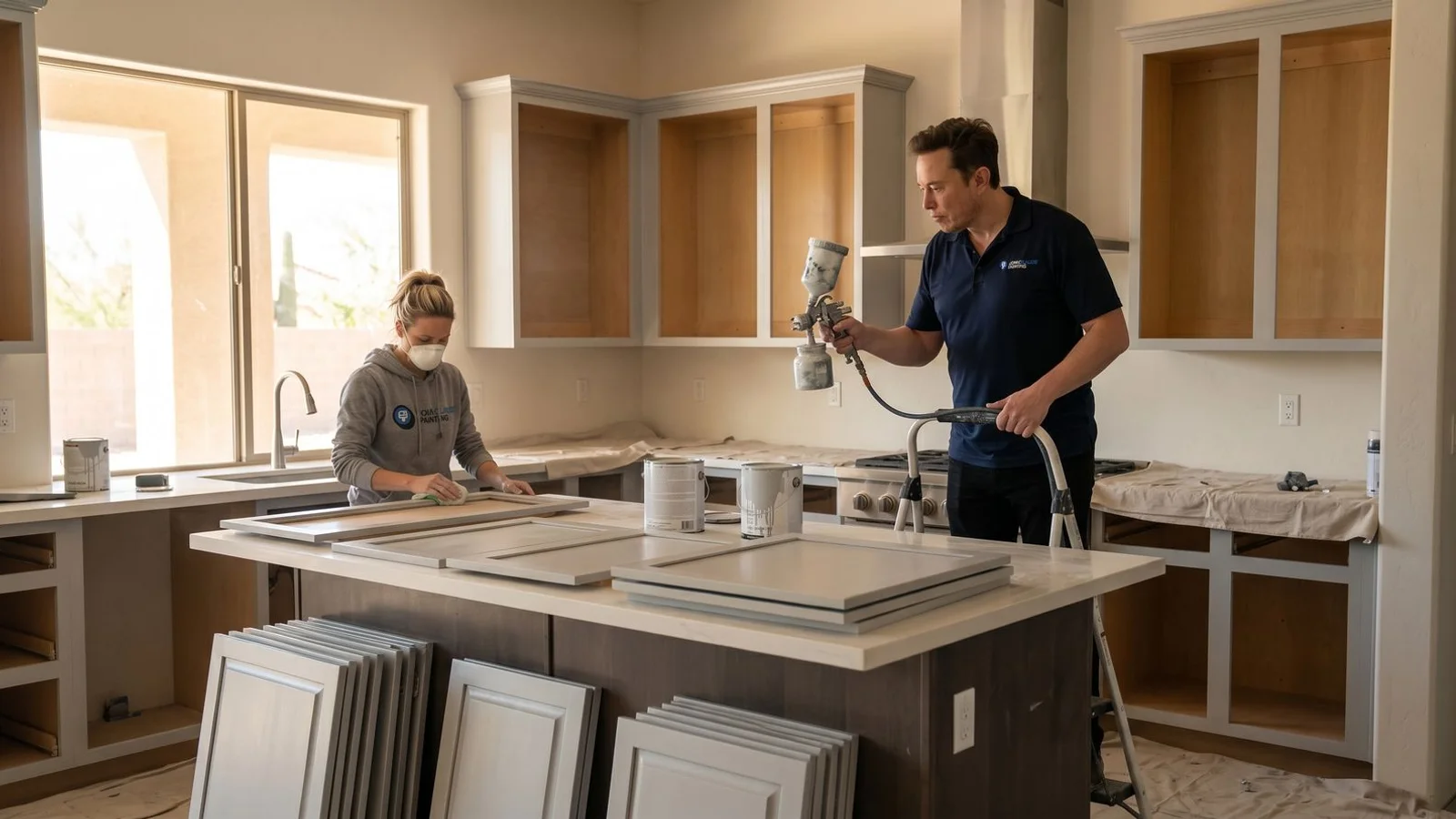
From what we have seen locally in 2026, updating your kitchen does not require a massive demolition budget.
Homeowners across the Phoenix Valley are discovering that a professional finish provides a huge upgrade for a fraction of the price. We consistently see a minor kitchen refresh yielding a 75% to 85% return on investment when it comes time to sell.
This approach protects your property value while dramatically modernizing your daily living space. Our team at John Claude Painting relies on proven methods to ensure these results survive the intense Arizona climate.
Let’s look at the exact data to understand the true cabinet painting cost arizona residents can expect this year.
Per-Door Pricing Tiers
The standard cabinet refinish price ranges between $85 and $300 per door or drawer front. We calculate this base rate using the specific profile of your woodwork and the required preparation steps.
Flat-panel styles naturally cost less, while intricate custom profiles demand extra labor. Our painters spend significant time masking and sanding detailed edges to ensure the final product looks factory-finished.
You will find the exact tier for your home below.
| Door Style & Substrate | Estimated Cost per Unit | Why It Costs What It Does |
|---|---|---|
| Flat-panel, painted substrate, satin | $85 to $120 | Easiest to sand and prep. |
| Flat-panel, oak or laminate | $110 to $160 | Requires heavy grain filling and bonding primer. |
| Raised-panel standard | $140 to $200 | Deep grooves require detailed hand-sanding. |
| Raised-panel with glaze or two-tone | $180 to $250 | Involves multiple finishing layers and custom masking. |
| Inset or custom profile doors | $200 to $300 | Demands highly precise shop-spraying. |
Whole-Kitchen Price Ranges
For a standard 30-door kitchen in the Phoenix area, the total cost to paint kitchen cabinets arizona style falls between $3,500 and $12,000. We find that mid-range upgrades average around $5,500 to $8,000 when using high-grade urethane enamels.
These figures scale up naturally if you have a massive layout or a large custom island. Our pricing model ensures transparency so you never face hidden fees at the end of a project.
Local cost data for 2026 shows an average professional job hovering around $2,289 to $3,188 for smaller or basic partial setups, but larger homes command the premium brackets.
- Flat-panel oak (Basic Renewal): $3,500 to $5,500. This includes a full bonding primer and a highly durable satin topcoat.
- Raised-panel (Premium Finish): $5,500 to $8,000. Upgrading to a modern, fingerprint-resistant matte finish adds massive value here.
- Glazed or two-tone (Luxury Custom): $7,500 to $12,000. We frequently spray dark charcoal base units while keeping upper boxes bright white.
- Large Kitchens: Installations exceeding 40 doors scale proportionally based on these same rates.
Cost Drivers
Several specific variables determine the final invoice for your renovation. We break down the exact costs by examining the number of doors, the material type, and your chosen finishes.
Total Door Count
The absolute number of doors and drawer fronts dictates your baseline material and labor requirements. We count every single removable piece during your initial consultation.
Pantry doors and exposed toe kicks heavily influence the final tally. Our estimators make sure nothing is missed.
Missing just three or four pieces can throw off a budget by hundreds of dollars.
Substrate Characteristics
What your boxes are made of determines the primer and prep work required. We adjust the base rate slightly depending on these surface conditions.
Raw wood needs minimal correction, but heavily grained 1990s oak demands extensive wood filler. Our technicians apply a high-quality bonding primer before the topcoat goes on.
- Already-painted wood: Baseline price.
- Raw or lightly-finished wood: Adds 5% to 10%.
- Oak: Requires a grain-fill option, adding 15% to 25%.
- Laminate and Thermofoil: Requires bonding primer, adding 10% to 20%.
- MDF: Edge-sealing scope adds 5% to 10%.
See our detailed guide on painting oak, laminate, and thermofoil cabinets for a comprehensive look at this exact preparation process.
Door Style
Slab fronts are the cheapest to cover because they lack deep profiles. We charge roughly 5% to 10% more for classic Shaker doors.
- Flat-panel (slab): Baseline price.
- Shaker: Adds 5% to 10%.
- Raised-panel: Adds 15% to 30% due to detailed hand-sanding in the tight corners.
- Inset: Adds 25% to 40% because shop-spraying is strictly required.
These tight corners trap dust, so painters must take extra precautions to prevent drips.
Finish Options
The sheen and color scheme you select can shift the project cost by up to 35%. We have seen a massive spike in two-tone requests for kitchen islands, which adds about 10% to 15%.
Satin and semi-gloss single colors remain the most cost-effective baseline. Our favorite product for the Arizona climate is Sherwin-Williams Emerald Urethane Trim Enamel.
- Two-Tone Layouts: Island and perimeter split adds 10% to 15%.
- Glaze Layers: Detailed accenting adds 15% to 25%.
- Distressed Looks: Antique finishing bumps the cost by 20% to 35%.
This water-based alkyd cures incredibly hard and resists the yellowing common with older oil paints.
In-Place vs Shop-Spray
Leaving the doors in your home costs less, but spraying them in a controlled environment yields a superior result. We highly recommend the shop-spray option for high-end properties.
Removing the pieces and taking them to a dust-free facility adds roughly 15% to 25% to the total bill. Our off-site method guarantees a glass-like finish free of desert dust.
In-place staging, where doors are sprayed on-site in a garage, remains the standard baseline option.
What’s Usually Included
A professional estimate should always cover the complete teardown, thorough preparation, and the final protective coatings. We provide a comprehensive service that leaves no detail up to chance.
Your quoted price guarantees a fully prepped surface cleaned with TSP to cut through grease. Our standard process includes two full coats of cabinet-grade topcoat.
This ensures the final finish survives heavy daily use.
- Teardown, Cleaning, and Prep: Safe removal and labeling of doors, followed by a thorough TSP wash and sanding.
- Priming and Painting: Bonding primer application (if required) and two coats of cabinet-grade topcoat.
- Hardware and Reassembly: Reinstallation of your existing hardware alongside precise hinge adjustments.
- Final Touches: A full punch-list walkthrough and a jar of labeled touch-up paint.
What’s NOT Usually Included
Most standard painting quotes strictly exclude structural modifications and brand-new hardware costs. We focus entirely on the finish rather than carpentry work.
Replacing broken drawer slides or adding new crown molding falls outside a typical painting agreement. Our crews generally skip interior box painting unless you specifically request an upgrade.
Leaving the interiors natural wood saves you significant money.
- New Hardware Purchases: Budget an extra $200 to $1,200 per kitchen if you want upgrades.
- Mechanical Repairs: Drawer slide replacements are handled separately.
- Interior Box Painting: Most estimates ignore the interiors to keep your costs down.
- Carpentry Enhancements: Trim molding replacement and new crown molding installation require a finish carpenter.
Hardware Swap, Worth It
Swapping out dated knobs for modern fixtures is absolutely worth the small added investment. We consistently observe a huge aesthetic upgrade when clients attach new handles to freshly painted doors.
Replacing hardware adds about $50 to $150 per cabinet, but the visual impact is tremendous. Our local designers note that matte black and brushed brass combinations are incredibly popular in 2026.
Most Phoenix kitchens look completely transformed with updated metal accents rather than paint alone.
Budget roughly $300 to $900 for new hardware on a typical setup. We highly recommend drilling any new holes before the painting process begins.
This simple step guarantees a flawless finish without ugly patching marks.
Payment Schedule
A standard industry contract requires a staggered payment approach rather than a lump sum upfront. We follow a fair scheduling model to protect both the homeowner and the contractor.
Avoid any painter who demands 100% of the funds before opening a single paint can. Our structure spreads the financial risk evenly across the project timeline.
| Project Milestone | Payment Percentage | What It Covers |
|---|---|---|
| At Signing | 30% Deposit | Secures your spot and covers initial materials. |
| Mid-Job | 50% Installment | Due after the primer coat is fully applied. |
| Completion | 20% Final Balance | Paid only after the final punch-list walkthrough. |
If you are ready to update your space, comparing your choices is the best next step.
We encourage every client to evaluate all their renovation avenues. Check out our cabinet painting service for quoting your specific kitchen.
Our team is always happy to provide a precise estimate. You can also read our guide on cabinet painting vs refacing vs replacement to see where painting fits in the cabinet decision.
We want you to feel completely confident before evaluating the best cabinet painting cost arizona has to offer. Make the call today to secure your spot on our schedule.
Quick Answers
How much to paint a mid-size Arizona kitchen?
$3,500-7,500 for a typical 30-door kitchen with flat panels, bonding primer, and two topcoat applications.
Do raised-panel doors cost more to paint?
Yes — 15-30% more per door due to profile spray and dry-time between faces.
Is swapping hardware worth doing during a paint?
Almost always. New knobs and pulls add $50-150 per cabinet for an outsized aesthetic upgrade.
Keep Reading
Best Paint and Finish for Kitchen Cabinets
Cabinet-grade paint chemistry and sheen explained — SW Emerald Urethane, BM Adva...
Cabinet Painting Timeline and What to Expect During the Job
The 3-7 day disruption of a cabinet repaint — door removal, spray booth, cure ti...
Cabinet Painting vs Refacing vs Full Replacement
The three-way cabinet decision honestly compared — cost deltas, lifespan, and wh...
Will Painted Cabinets Chip, Peel, or Hold Up Long-Term?
The real reasons painted cabinets fail — and what proper prep, bonding primer, a...
Need a Real Estimate?
We'll walk your property and write a scoped proposal within 24 hours — no cost, no obligation.